 Horror News | HNN Official Site | Horror Movies,Trailers, Reviews
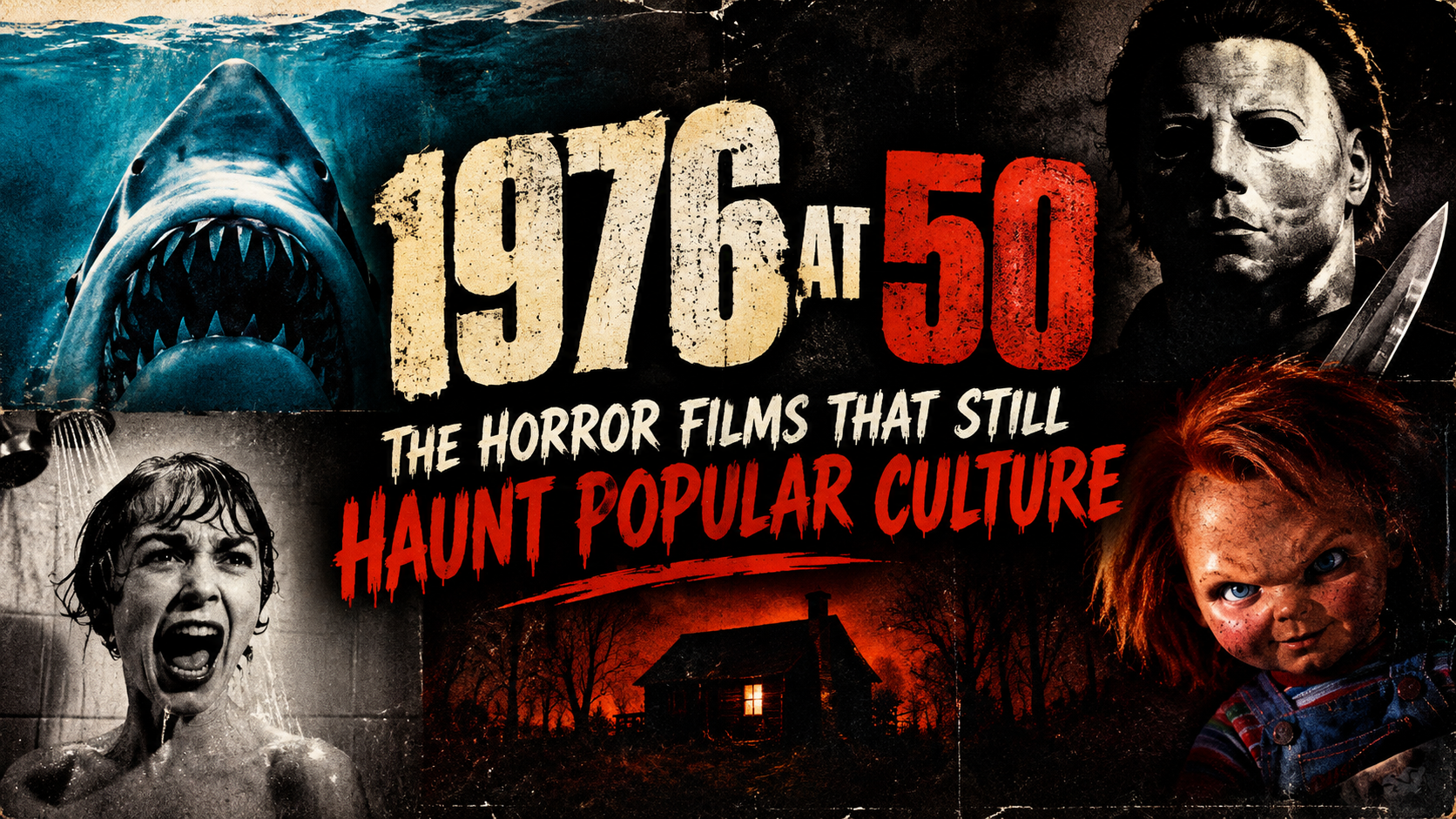
Half a century is a long time. Monsters change, taboos move and techniques that once terrified audiences can become familiar enough to parody. Yet some films refuse to become museum pieces.
1976 was an unusually revealing year in that respect. The Exorcist had already demonstrated that supernatural horror could become a mainstream cultural event, while The Texas Chain Saw Massacre had dragged audiences somewhere much dirtier and less comfortable. Halloween, which would help establish the rules of the modern slasher, was still two years away.
Caught between those landmarks, 1976 produced horror films heading in remarkably different directions. One turned teenage humiliation into supernatural catastrophe. Another transformed the Antichrist into a major Hollywood attraction. Elsewhere, a house became a predator, children became the threat and one of Britain’s defining horror studios reached the end of an era.
Fifty years later, their influence is easier to see.
Carrie Made Teenage Life Terrifying
Brian De Palma’s Carrie was the first Stephen King novel to reach the screen, and its importance extends well beyond introducing Hollywood to an author whose work would eventually become almost inseparable from horror cinema. HorrorNews’ own review of Carrie revisits just how effectively Sissy Spacek turns Carrie White into a character audiences fear for long before they fear her.
The film is special because the supernatural element is almost secondary at first. Carrie’s world is already frightening. She is bullied at school, controlled at home by her fanatically religious mother and humiliated for failing to understand the changes happening to her own body. Telekinesis eventually gives those anxieties explosive physical form, but De Palma spends enough time with Carrie that the prom massacre feels less like the arrival of a conventional monster than the catastrophic breaking point of a victim.
That tension helped make the blood-soaked image of Carrie at the prom one of horror’s most recognisable visual shorthand. It has survived sequels, remakes, stage versions and decades of references, while the character continues to circulate through posters, clothing and horror movie collectibles.
The story is about to be introduced to another generation. Mike Flanagan’s eight-episode Carrie arrives on Prime Video on October 7, 2026, becoming the first television-series adaptation of King’s novel. Fifty years after Spacek walked onto that prom stage, Hollywood is still returning to Carrie White.
The Omen Turned Occult Horror into an Event
If Carrie makes horror painfully intimate, Richard Donner’s The Omen operates on a much grander scale.
Gregory Peck plays American diplomat Robert Thorn, whose apparently ordinary young son may actually be the Antichrist. The settings are affluent, international and respectable. Evil does not emerge from an isolated castle or shadowy crypt. It enters embassies, country estates and the lives of powerful people.
Following the enormous success of The Exorcist, The Omen showed how confidently a major studio could sell supernatural horror as prestige entertainment. Its publicity campaign was itself unusually ambitious, using advance screenings and extensive trailer advertising to generate anticipation. The film’s obsession with 666 also gave marketers an irresistible image to build around.
The film offered more than a satanic gimmick. Donner largely avoids filling the screen with obvious demonic imagery. Instead, uncertainty surrounds Damien and the increasingly terrible events around him. That restraint helped distinguish The Omen from many of the era’s more overt excursions into satanic horror.
Its afterlife has been considerable: sequels, television adaptations, a 2006 remake and, most recently, The First Omen have continued to expand Damien’s mythology. What began as a 1976 studio gamble became a horror franchise capable of surviving for generations.
Burnt Offerings Made the House the Monster
Haunted houses were hardly new in 1976, but Dan Curtis’ Burnt Offerings did something particularly nasty with the idea.
Ben and Marian Rolf move with their family into an enormous old mansion for the summer. Gradually, it becomes apparent that the property is not simply haunted by something that lives inside it. The house itself seems to rejuvenate as the people occupying it deteriorate.
Instead of providing a location in which the horror occurs, the building becomes an active participant. The characters are effectively feeding it.
The idea also connects the story to one of horror’s most famous fictional hotels. Stephen King acknowledged a debt to Robert Marasco’s original Burnt Offerings novel while writing The Shining, placing the story within a lineage of haunted buildings that do far more than simply contain ghosts.
For anyone rediscovering the film at 50, HorrorNews’ retrospective review of Burnt Offerings also makes a strong case for the mansion itself being the real star.
Who Can Kill a Child? Asked a More Uncomfortable Question
Not all of 1976’s important horror came from Hollywood.
Spanish director Narciso Ibáñez Serrador’s Who Can Kill a Child? begins with a deceptively simple nightmare. An English couple travels to an island expecting a quiet holiday and discovers that almost all the adults have disappeared. The children remain.
Then they learn why.
A film built around murderous children could easily have settled for provocation, but Serrador gives the premise a much darker political undercurrent. The film opens with images recalling real conflicts and atrocities in which children were victims. Long before its adult protagonists face the possibility of killing children themselves, the movie has reminded viewers how frequently adults have done exactly that on a vastly greater scale.
That makes the film more troubling than its exploitation-friendly premise suggests. The adults are horrified because children have violated the expected order of things, yet the opening forces us to ask who taught them violence in the first place.
It remains one of the year’s best reminders that horror’s power often comes from taking something audiences consider safe and changing the rules around it.
To the Devil a Daughter Marked the End of Old Hammer Horror
While American horror was becoming bigger, slicker and more commercially ambitious, one of Britain’s great horror institutions was struggling to adapt.
For nearly two decades, Hammer Films had helped define British screen horror through its colourful Gothic interpretations of Dracula, Frankenstein and other classic subjects. By the early 1970s, however, the genre was moving rapidly around it. Films including Night of the Living Dead, Rosemary’s Baby, The Exorcist and The Texas Chain Saw Massacre were making contemporary horror feel dangerous in ways Hammer’s traditional Gothic formula increasingly struggled to match.
To the Devil a Daughter, starring Christopher Lee, Richard Widmark and Nastassja Kinski, was an attempt to move towards that newer world. Hammer Films describes the Dennis Wheatley adaptation as its final horror film of the original era and its only venture into “modern” horror.
The film arrived after Hammer had released no new features in 1975 and effectively marked the end of the studio’s original run as a major producer of horror cinema.
That gives 1976 an intriguing symmetry. While Carrie was opening the door to decades of Stephen King adaptations and The Omen demonstrated the commercial possibilities of expensive studio horror, the company that had dominated an earlier age of the genre was reaching the end of its original run.
Fifty Years Later, 1976 Is Still With Us
What makes these films interesting at 50 is not simply that people still watch them. Horror is particularly good at keeping its past active.
Carrie’s prom remains visual shorthand for revenge and humiliation. Damien is still one of cinema’s definitive evil children. Burnt Offerings belongs to a haunted-house tradition that continues to reinvent itself, while Who Can Kill a Child? still poses a moral question capable of making audiences uncomfortable. Hammer, meanwhile, has returned as an active studio, meaning even the apparent ending represented by To the Devil a Daughter was not permanent.
The distance between 1976 and 2026 can look enormous until you examine the horror people are watching. Then the distance becomes surprisingly small.