 Horror News | HNN Official Site | Horror Movies,Trailers, Reviews
Horror fans know the feeling.
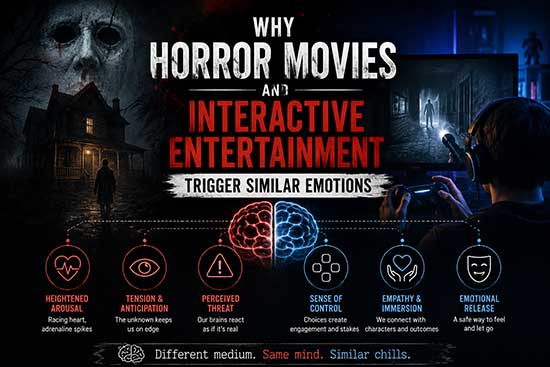
Your heart rate rises. Your attention narrows. Every sound suddenly seems important. Whether you’re watching a horror film late at night or navigating a tense moment in a game, the emotional response can feel remarkably similar.
That isn’t a coincidence.
Although horror movies and interactive entertainment are very different forms of media, they often rely on the same psychological tools to create suspense, anticipation, and excitement. Both experiences place audiences in situations where uncertainty becomes part of the entertainment.
The result is a unique blend of fear, curiosity, and adrenaline that keeps people coming back for more.
Suspense Thrives on the Unknown
One of the most important ingredients in horror is uncertainty.
Viewers rarely feel scared because they know exactly what will happen next. The tension comes from not knowing. A dark hallway, an unexplained sound, or an empty room can create anxiety long before anything actually appears.
Interactive entertainment uses the same principle.
Players constantly wonder what might be around the next corner, what decision will lead to the best outcome, or whether an unexpected event is about to occur. The uncertainty itself becomes engaging.
In both cases, the imagination often does as much work as the content on screen.
Sound Design Drives Emotional Reactions
Audio plays a massive role in creating tension.
A sudden silence before a scare. Distant footsteps echoing through an abandoned building. A subtle change in background music that signals something isn’t right.
Horror films have relied on these techniques for decades.
Interactive entertainment uses many of the same methods. Sound cues help build atmosphere, guide attention, and create emotional pacing. Even when nothing visible is happening, audio can make audiences feel uneasy or excited.
That’s why strong sound design remains one of the most powerful tools available to creators.
The Brain Enjoys Safe Fear
At first glance, it seems strange that people voluntarily seek frightening experiences.
Yet psychologists have long noted that controlled fear can be enjoyable. Audiences know they are safe while watching a horror movie or playing a game, allowing them to experience adrenaline without real danger.
This creates a unique emotional balance.
People get the excitement of uncertainty while remaining in a secure environment. That combination often feels thrilling rather than overwhelming.
It’s one reason horror continues to attract dedicated audiences around the world.
Immersion Makes Emotions Stronger
The more immersive an experience becomes, the stronger its emotional impact tends to be.
Horror movies use cinematography, music, lighting, and pacing to pull viewers into the story. Interactive entertainment adds another layer by making people active participants rather than passive observers.
Instead of simply watching events unfold, players influence what happens next.
That involvement often increases emotional investment because decisions feel personal. Successes feel rewarding. Mistakes feel consequential. Tense moments become more memorable because audiences are directly involved.
Modern Technology Blurs the Line
Advances in technology continue bringing different forms of entertainment closer together.
Games increasingly adopt cinematic storytelling techniques, while films experiment with more interactive formats and audience participation. Streaming platforms, mobile devices, and digital distribution have made immersive entertainment more accessible than ever.
Modern mobile gaming platforms are part of that broader trend. Many users now prefer direct smartphone access for convenience and flexibility while downloading entertainment platforms through download MelBet (Arabic: تحميل ميل بت) directly onto mobile devices.
The common thread is accessibility.
People expect engaging experiences to be available wherever they are.
Anticipation Often Feels Stronger Than the Payoff
One fascinating aspect of horror is that anticipation is often more powerful than the event itself.
The moments before the scare can feel more intense than the scare itself. The same applies to many interactive experiences.
A difficult decision, a close outcome, or a tense sequence often creates stronger emotions than the final result.
Creators understand this well.
Building anticipation keeps audiences emotionally invested and encourages them to stay engaged.
Communities Extend the Experience
Another reason horror remains popular is the community surrounding it.
Fans discuss theories, share reactions, recommend films, and revisit memorable moments long after the credits roll. Interactive entertainment generates similar behavior.
People enjoy talking about surprising outcomes, emotional scenes, and unforgettable experiences with others who understand the appeal.
The conversation becomes part of the entertainment itself.
Both Forms of Entertainment Reward Attention
Horror movies and interactive experiences both encourage audiences to pay close attention.
Small visual details, background sounds, hidden clues, and subtle foreshadowing often become important later. This active engagement creates a stronger connection between the audience and the content.
People feel rewarded for noticing details.
That sense of participation helps make both experiences more memorable.
Why These Emotions Remain So Effective
Despite changes in technology, the underlying emotional triggers remain remarkably consistent.
Suspense, uncertainty, anticipation, and immersion continue to resonate because they tap into fundamental aspects of human psychology. Horror creators and game designers may use different tools, but they often aim for similar emotional outcomes.
The goal isn’t simply to scare people.
It’s to make them feel something.
Final Thoughts
Horror movies and interactive entertainment trigger similar emotions because they rely on many of the same psychological foundations.
Both use suspense, sound design, uncertainty, and immersion to create experiences that capture attention and generate strong emotional reactions. Whether someone is watching a terrifying film or navigating a tense interactive scenario, the emotional journey often follows surprisingly similar paths.
And that’s exactly what keeps audiences coming back for the next thrill.