 Horror News | HNN Official Site | Horror Movies,Trailers, Reviews
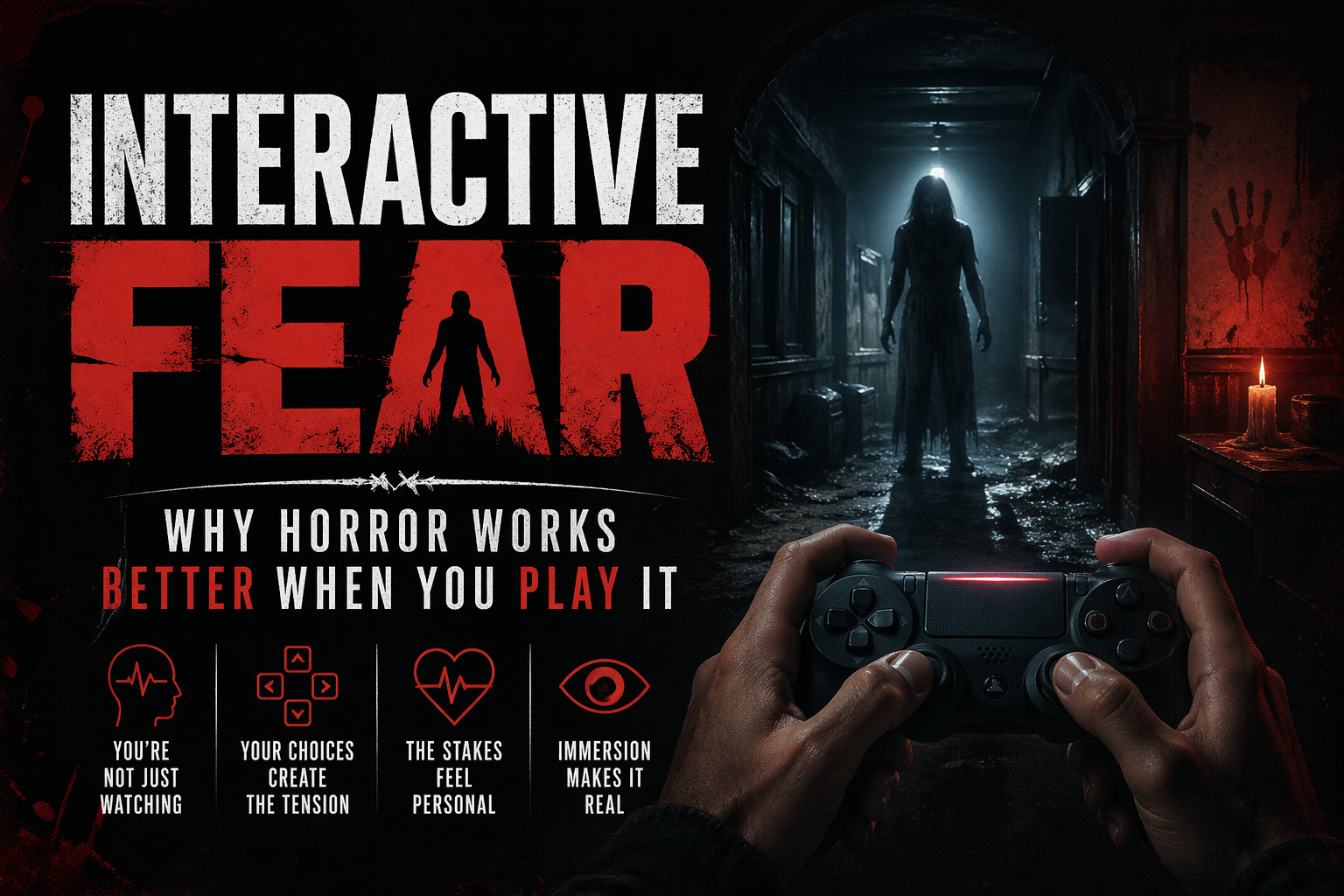
Horror has always known how to get under the skin. A strange noise in the next room. A figure standing just a second too long in the background. A silence that feels wrong. In film and television, those moments work because the audience is trapped in the director’s hands. We are shown exactly what to see, when to see it, and how long to sit with the dread. But horror changes when we stop watching and start participating.
That is where interactive horror does something films often cannot. It turns fear into responsibility. The monster is still there. The darkness is still there. The sound design still matters. But now the audience has to move, choose, hesitate, open the door, walk down the corridor, or decide whether to keep going at all. Fear becomes less like a performance and more like an experience. Horror has always adapted well across formats, and that bleeds into other digital spaces.
Why passive horror still works
None of this means traditional horror has stopped being effective. Far from it. Film still does some things better than any other format. It controls pacing with incredible precision. It can hold a shot for exactly as long as needed, cut away at the right moment, and use music or silence to guide the viewer’s nerves. A great horror film can make you feel helpless in the best possible way. You are stuck on its rails.
But that is also the limit. As a viewer, you are still a witness. You are frightened, but you are not implicated. The character opens the basement door, not you. The character walks into the woods, not you. The audience suffers with them, but at a distance. Interactive horror removes some of that safety. It hands over just enough control to make you complicit.
Why participation makes fear heavier
That is the real difference. Control makes fear more personal, not less. In theory, having agency should make things easier. In horror, it often makes things worse. Once the player is involved, every bad outcome feels partly self-inflicted. You chose to go down the hallway. You stayed too long in the room. You used the wrong resource too early. You kept moving when you should have stopped.
That extra layer of responsibility deepens the emotion. Fear is no longer just about what might happen to someone on screen. It becomes about what might happen because of you. This is why interactive horror often lingers differently. It creates a stronger sense of presence. The tension is not neatly contained within a running time. It sits in your body. Your decisions shape the rhythm. Your hesitation becomes part of the atmosphere. Even a simple mechanic, like having to push open a door slowly or choose between hiding and running, can make a scene far more intense than passively watching the same moment in a film.
How games changed the genre
Video games gave horror something it had always wanted: vulnerability with consequence. Survival horror, especially, understood this early. Limited resources, weak characters, confusing maps, hostile spaces, and the constant fear of being underprepared all helped redefine what horror could do. It was no longer just about what was seen. It was about what had to be managed.
That made exploration frightening in a different way. In a film, the haunted house is a setting. In a game, it becomes a problem. You have to navigate it, remember it, survive it. Sound changes when you move. Enemies react to your actions. The environment starts to feel alive because it responds to you.
That responsiveness is part of why horror in games often has more replay value than horror in film. A movie may still work on repeat viewings, but the broad path is fixed. A game has more room for variation. You take a different route. You miss something. You panic earlier. You make a better decision. The fear may not disappear, but it shifts shape.
Horror is spreading into more interactive formats
What is interesting now is that horror is no longer confined to traditional survival horror games. It has spread outward. You can see it in mobile games, interactive fiction, smaller indie experiments, escape-room design, VR experiences, and even lighter digital formats that borrow horror imagery without building a full horror world. That expansion into lighter and more varied interactive formats has also influenced categories like horror themed slot games, where familiar genre imagery, dark houses, monsters, occult symbols, ominous sound cues, is folded into simpler, faster gameplay structures.
That matters because it shows how flexible horror really is. It does not need one fixed structure to survive. It can be stripped down to symbols and mood, or stretched out into long, oppressive experiences. The core emotions still travel well.
Why horror adapts so easily
Part of horror’s strength is that its building blocks are instantly readable. Darkness means danger. A child’s voice in the wrong place feels wrong. A sudden drop in ambient sound makes the body tense before the brain catches up. Monsters, mirrors, abandoned spaces, distorted sound, things watching from just outside the frame, these cues work across almost every medium because they tap into old instincts.
Horror is also unusually comfortable with uncertainty. It does not need total clarity to work. In fact, it often works better without it. That is why it fits interactive media so well. Games are full of uncertainty already: where to go, what to trust, what is behind the next door. Horror simply sharpens those questions.
The future is even more personal
As technology keeps evolving, interactive horror is likely to become more reactive and more intimate. VR and AR will push immersion further. AI-driven systems may start adjusting pacing, sound, or environmental behaviour based on how individual players move through a scene. That means fear could become less standardized and more personal. And that feels right for the genre.
Because horror has always been strongest when it gets close, when it stops feeling like something observed from a safe seat and starts feeling like something you are inside. The more horror asks us to participate, the harder it becomes to keep fear at a safe distance.